
















Residential vs Commercial Property in Gurgaon: Key Differences
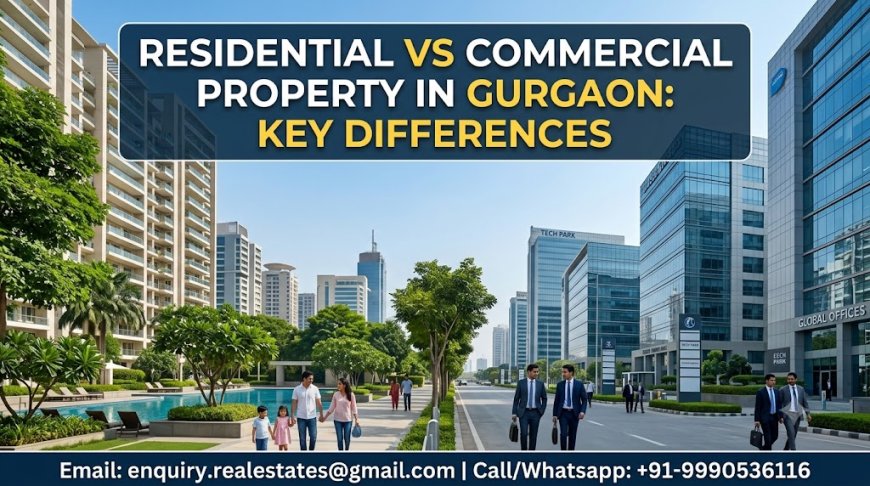
Explore residential vs commercial property in Gurgaon: key differences in rental yield, entry cost, capital appreciation, lease terms, and HRERA rules.

Residential vs Commercial Property in Gurgaon: Key Differences
1. Capital Entry Requirements & Ticket Size
-
Residential Investments: Offer flexible entry price points. A modern 2BHK or 3BHK apartment in growing corridors like Dwarka Expressway or New Gurgaon requires an investment of ₹1.2 Crore to ₹2.5 Crore. Premium luxury units on Golf Course Road or Golf Course Extension Road range from ₹3.5 Crore to over ₹12 Crore.
-
Commercial Investments: Generally demand larger initial capital allocations. Grade-A office spaces or premium high-street retail shops along major corridors like Golf Course Extension Road or Southern Peripheral Road (SPR) typically require entry budgets between ₹2.5 Crore and ₹10+ Crore. Fractional ownership platforms have emerged as a lower-cost entry alternative, but direct ownership of Grade-A commercial real estate remains a capital-intensive asset class.
2. Gross Rental Yields and Income Stability
-
Residential Rental Yields: Typically range between 3.2% and 4.8% annually across Gurgaon. While residential yields are lower, tenant demand remains consistent due to the steady influx of corporate professionals working across Cyber City, Golf Course Road, and SPR.
-
Commercial Rental Yields: Command substantially higher gross yields, ranging from 7.0% to 9.5% annually for Grade-A office assets and 8.0% to 11.0% for prime high-street retail spaces. Commercial leases also feature long lock-in periods (typically 3 to 9 years) with structured rent escalation clauses (e.g., 15% escalation every 3 years), delivering predictable long-term cash flows.
Comprehensive Comparison Matrix: Residential vs Commercial
| Parameter | Residential Property | Commercial Property |
| Average Gross Yield | 3.2% – 4.8% per annum | 7.0% – 9.5% (Office) / 8.0% – 11.0% (Retail) |
| Lease Duration | 11 months to 2 years | 3 to 9 years (with 3-to-5 year lock-ins) |
| Rent Escalation | 5% – 10% annually or upon renewal | 15% every 3 years (contractually bound) |
| Tenant Profile | Families, Corporate Employees, Individuals | MNCs, Tech Firms, Retail Chains, Banks |
| Vacancy Risk | Low to Moderate (Quick tenant replacement) | Moderate to High (Longer lease negotiation cycles) |
| Maintenance Burden | Landlord handles structural upkeep; Tenant pays operational maintenance | Often structured as Double or Triple Net Leases (Tenant covers taxes, insurance, & upkeep) |
| Mortgage LTV Ratios | Up to 75% – 80% Loan-to-Value | 50% – 60% Loan-to-Value (Higher interest rates) |
| Capital Appreciation | Higher percentage growth in expanding residential belts | Steady, yield-compressed valuation tied to lease terms |
Micro-Market Distribution Across Gurgaon Corridors
1. Golf Course Road & Cyber City (Prime Trophy & Commercial Hub)
2. Golf Course Extension Road & Southern Peripheral Road (SPR)
3. Dwarka Expressway Corridor (NH-248BB)
Evaluating Operational Risks and Lease Structures
Lease Architecture and Lock-In Protections
Taxation, Maintenance, and Management Realities
-
GST Application: Residential rent collected for personal housing is exempt from GST. However, commercial rent attracts 18% GST if the landlord’s annual gross rental income exceeds the ₹20 Lakh threshold.
-
Property Taxes & Expenses: Municipal taxes for commercial assets are significantly higher than for residential units. However, commercial leases are frequently structured as Triple Net Leases (NNN), requiring corporate tenants to pay property taxes, insurance, and common area maintenance (CAM) directly.
-
Fit-Out Costs: Commercial spaces are often handed over as bare-shell units, requiring upfront capital expenditures (CapEx) for fit-outs, partitions, and interior infrastructure—though these are often funded or amortized by the tenant in exchange for longer lease terms.
-
Target Clear Investment Goals: Choose commercial assets if your primary objective is high, contractually bound rental income (7% to 9.5%+). Choose residential assets if you prioritize lower entry costs, high resale liquidity, and steady capital growth.
-
Evaluate Lease Duration Differences: Commercial leases offer multi-year stability with structured 15% rent escalations every 3 years. Residential leases operate on 11-month or 2-year cycles with lower switching friction.
-
Account for Taxation and GST: Commercial rental income above ₹20 Lakhs per year attracts 18% GST, whereas residential leases for personal use remain GST-exempt.
-
Understand Micro-Market Alignment: Established belts like Golf Course Road and SPR offer strong dual demand for both Grade-A office spaces and luxury gated residential developments.
-
Budget for Fit-Out and Vacancy Costs: Commercial properties carry higher fit-out costs and longer vacancy periods between tenants, while residential properties can be re-leased much faster.
Frequently Asked Questions
Which asset class offers higher rental yields in Gurgaon?
Commercial property delivers higher gross rental yields (7.0% to 9.5% for office space, 8.0% to 11.0% for retail) compared to residential property, which typically generates 3.2% to 4.8% annually.
What is the minimum capital required to invest in Gurgaon commercial property?
Direct ownership of Grade-A commercial spaces or prime retail shops usually requires an initial capital budget ranging from ₹2.5 Crore to ₹10+ Crore.
Are residential properties easier to resell than commercial assets in Gurgaon?
Yes, residential properties generally offer higher liquidity and a broader pool of buyers, allowing owners to sell faster compared to high-ticket commercial assets.
How do lease agreements differ between residential and commercial properties?
Commercial leases run for 3 to 9 years with strict multi-year lock-in clauses and 15% rent escalations every 3 years. Residential leases operate on 11-month to 2-year contracts with 1 to 2-month notice periods.
Does commercial rental income attract GST in India?
Yes, commercial rental income is subject to 18% GST if the property owner’s aggregate annual turnover exceeds ₹20 Lakhs. Residential renting for personal residential use is exempt from GST.
Which micro-markets in Gurgaon are best for commercial real estate?
Golf Course Road, Cyber City, Southern Peripheral Road (SPR), and Golf Course Extension Road are the top micro-markets for Grade-A office spaces and premium retail investments.
What is a Triple Net Lease (NNN) in commercial real estate?
A Triple Net Lease requires the tenant to cover all property taxes, building insurance, and common area maintenance (CAM) costs in addition to their base monthly rent.
Is financing easier to secure for residential or commercial properties?
Residential home loans offer higher Loan-to-Value (LTV) ratios (up to 75%–80%) and lower interest rates. Commercial property loans feature lower LTV ratios (50%–60%) and slightly higher interest rates.
What are the risks associated with investing in commercial real estate?
Key risks include longer vacancy periods between corporate tenants, tenant default during economic downturns, higher fit-out costs, and higher initial capital requirements.
Why do corporate professionals prefer master-planned residential townships?
Master-planned townships offer 24/7 security, athletic facilities, landscaped parks, power backup, and integrated retail zones, making them highly attractive to corporate tenants.
Final Thoughts